A changing interval
Bring near-bit formation response into the steering discussion when sensor position affects how the team interprets a boundary.
Inclination and gamma measured close to the cutting structure, with a published 12-inch sensor offset.
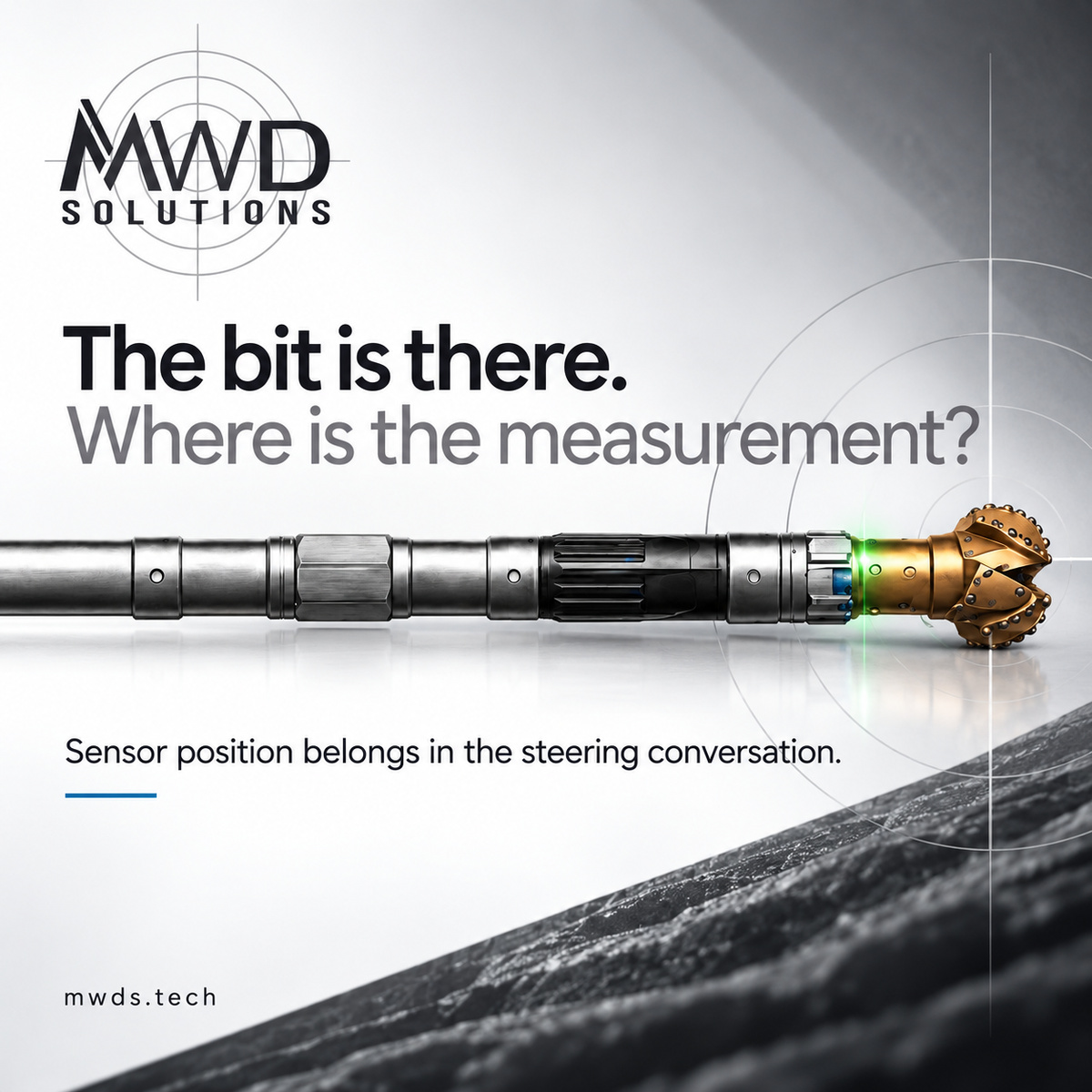
Positioned between the motor and bit, Near-Bit Measurement measures inclination, azimuth, gamma and azimuthal gamma near the cutting structure. An EM short-hop carries data to a receiver in the MWD string for transmission to surface.
Bring near-bit formation response into the steering discussion when sensor position affects how the team interprets a boundary.
Review inclination and gamma close to the bit alongside the geological prognosis and the other measurements available.
Evaluate near-bit directional and azimuthal gamma information with the planned trajectory and formation context.
Simplified communication sequence. The short-hop and the surface telemetry are separate links; both need to be reviewed for the application.
Review these interfaces and limitations with MWD Solutions as part of the tools-and-personnel package.
Review your configurationThe transmitter sub sits below the motor. Confirm tool size, connections, makeup torque and the applicable sliding and rotating dogleg limits.
An EM short-hop sends data to a receiver in the MWD string. The MWD system then transmits it to surface; this is not a direct bit-to-surface link.
The receiver arrangement supports retrieval of the MWD. The near-bit transmitter sub itself is not made retrievable by that arrangement.
Published product parameters and configuration notes. Confirm the current assembly rating before use.
Read the original PDF| Parameter | Published value |
|---|---|
| Inclination accuracy | ±0.25° |
| Inclination range | 0–180° |
| Sensor / gamma offset | 12 in |
| Gravity accuracy | 0.0005 G |
| Gravity range | 0–2 G |
| Gamma resolution | 1 AAPI |
| Gamma range | 0–1023 |
| Temperature | 175°C / 347°F |
| Parameter | Published value |
|---|---|
| Formation resistivity | 2–200 ohm·m optimal |
| Mud system | Water- or oil-based |
| Differential pressure | Avoid spikes above 300 psi |
| Torque | Avoid spikes above 1,500 ft·lbf |
| Rotary measurement limit | 250 rpm, motor + string combined |
| Axial shock | 20 G maximum |
| Agitator separation | 800 m / 2,625 ft behind |
| Reaming | Keep to an absolute minimum |
| Battery, inclination + gamma | 160 hours per 14 V cell |
| Battery, inclination + azimuthal gamma | 128 hours per 14 V cell |
Battery figures are published per-cell figures, not guaranteed run duration.
Scroll horizontally to compare tool sizes
| Nominal tool size | 4.75 in | 6.5 in | 8 in |
|---|---|---|---|
| Length | 34 in | 34 in | 34 in |
| Diameter | 5.0 in | 6.5 in | 8.0 in |
| Makeup torque (ft·lbf) | 14,200 | 23,000 | 57,000 |
| Max drilling torque (ft·lbf) | 9,900 | 22,500 | 47,000 |
| Surface RPM | 30 | 50 | 50 |
| Max sliding dogleg (°/100 ft) | 28 | 20 | 12 |
| Max rotating dogleg (°/100 ft) | 12 | 10 | 7 |
Confirm connections and use the limits for the selected tool size and assembly.
Use the technical reference for an organized specification review. The original brochure is retained alongside it and may use the product’s earlier name.
The short-hop signal, receiver configuration and operating limits need to be reviewed as part of the complete BHA.
More field perspectives