Formation boundaries
Compare the gamma response around the hole when a bulk response leaves uncertainty about the direction of a formation change.
Azimuthal gamma preserves directional information that is combined into a single value in a bulk gamma measurement.
Four gamma sensors in one retrievable probe provide selectable azimuthal bins, up/down sliding measurements and rotary inclination. The module is designed to replace the gamma module in a compatible MWD string.
Compare the gamma response around the hole when a bulk response leaves uncertainty about the direction of a formation change.
Use selectable azimuthal bins during rotation and up/down gamma during slides, with sampling configured for the application.
Evaluate boundary patterns with the image reference and geological model before deciding what they mean for the well path.
4 bins divide the circumference into 90° windows.
The probe still has four detectors. Bin count describes how the azimuthal response is grouped, not the number of sensors.
Conceptual sectors only; this is not a measured gamma image. Confirm sampling and surface decoding for the selected mode.
Review these interfaces and limitations with MWD Solutions as part of the tools-and-personnel package.
Review your configurationThe retrievable four-detector probe is designed to replace a compatible gamma module. Confirm mechanical, electrical and data interfaces.
The brochure specifies a PDT surface decoder for the compressed gamma data. Confirm the decoder and data workflow before mobilization.
The published maximum is 100 rpm. Agree on bin count, sampling, filtering and the real-time data allocation for the planned operation.
Published product parameters and configuration notes. Confirm the current assembly rating before use.
Read the original PDF| Parameter | Published value |
|---|---|
| Probe diameter | 1.875 in |
| Probe length | 69.5 in |
| End connections | 10-pin Kintec |
| Operating pressure | 20,000 psi |
| Operating temperature | 175°C / 347°F |
| Random vibration, 50–1000 Hz | 20 G, three axes |
| Z-axis shock | 500 G / 0.5 ms |
| X/Y-axis shock | 1,000 G / 0.5 ms |
| Sensitivity | 0.2 CPS |
Confirm the input-voltage range for the selected module before electrical integration.
| Parameter | Published value |
|---|---|
| Two-bin gamma | 180° windows |
| Four-bin gamma | 90° windows |
| Eight-bin gamma | 45° windows |
| Rotary inclination accuracy | ±0.25° |
| RPM accuracy | ±1 rpm |
| Maximum RPM | 100 rpm |
| Shock measurement range | 100 G |
| Shock measurement accuracy | ±1 G |
| RMS vibration accuracy | ±1 G |
| Shock-count threshold | Field programmable |
| Temperature resolution | 1°C |
Confirm the selected sampling configuration and transmitted channels before the run.
Use the technical reference for an organized specification review. The original brochure is retained alongside it and may use the product’s earlier name.
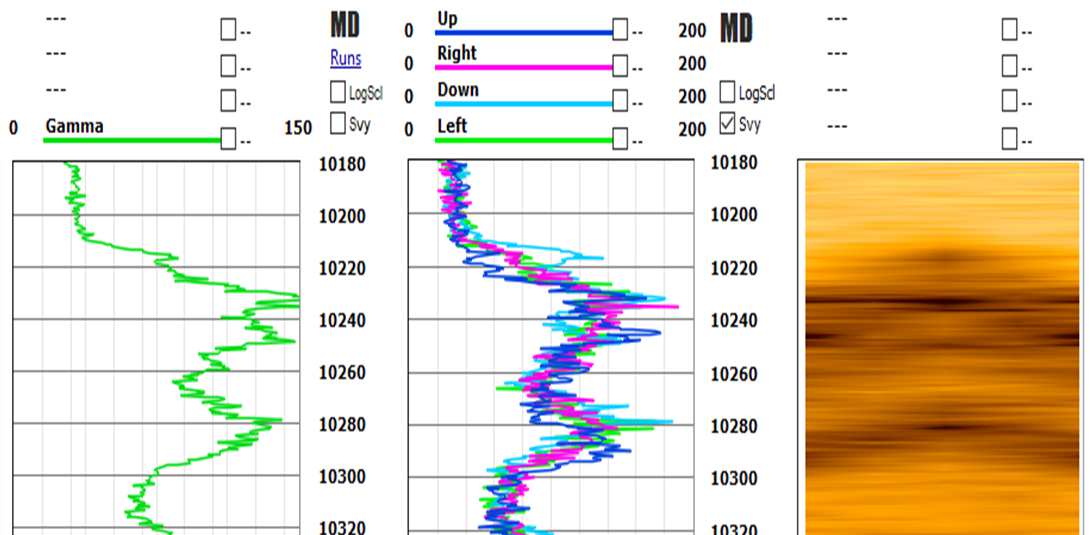
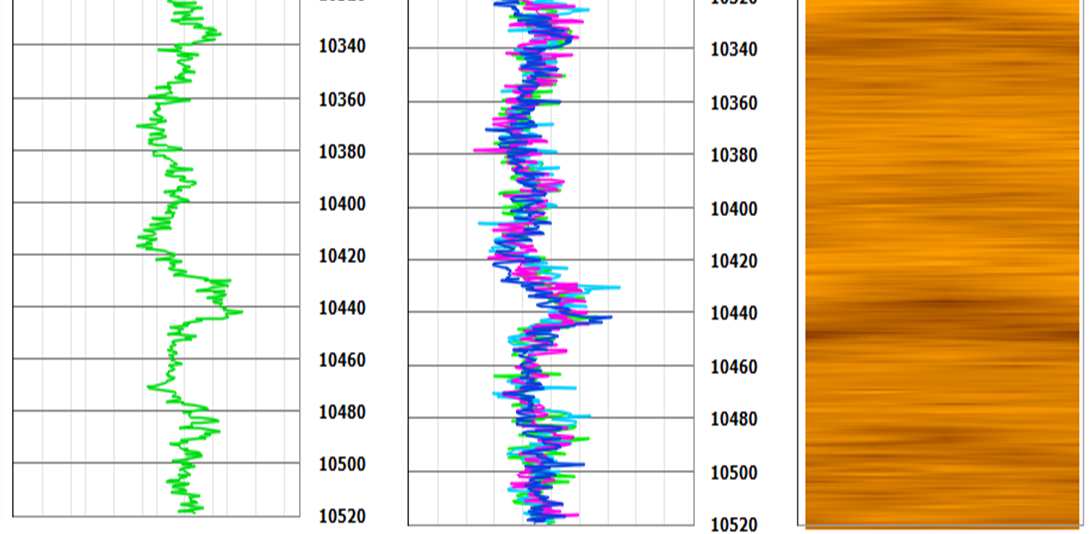
The brochure places bulk gamma, directional curves and an azimuthal image alongside one another.
Each view preserves different information. Review the image reference, trajectory and geological setting before assigning meaning to a boundary pattern.
Open the full brochure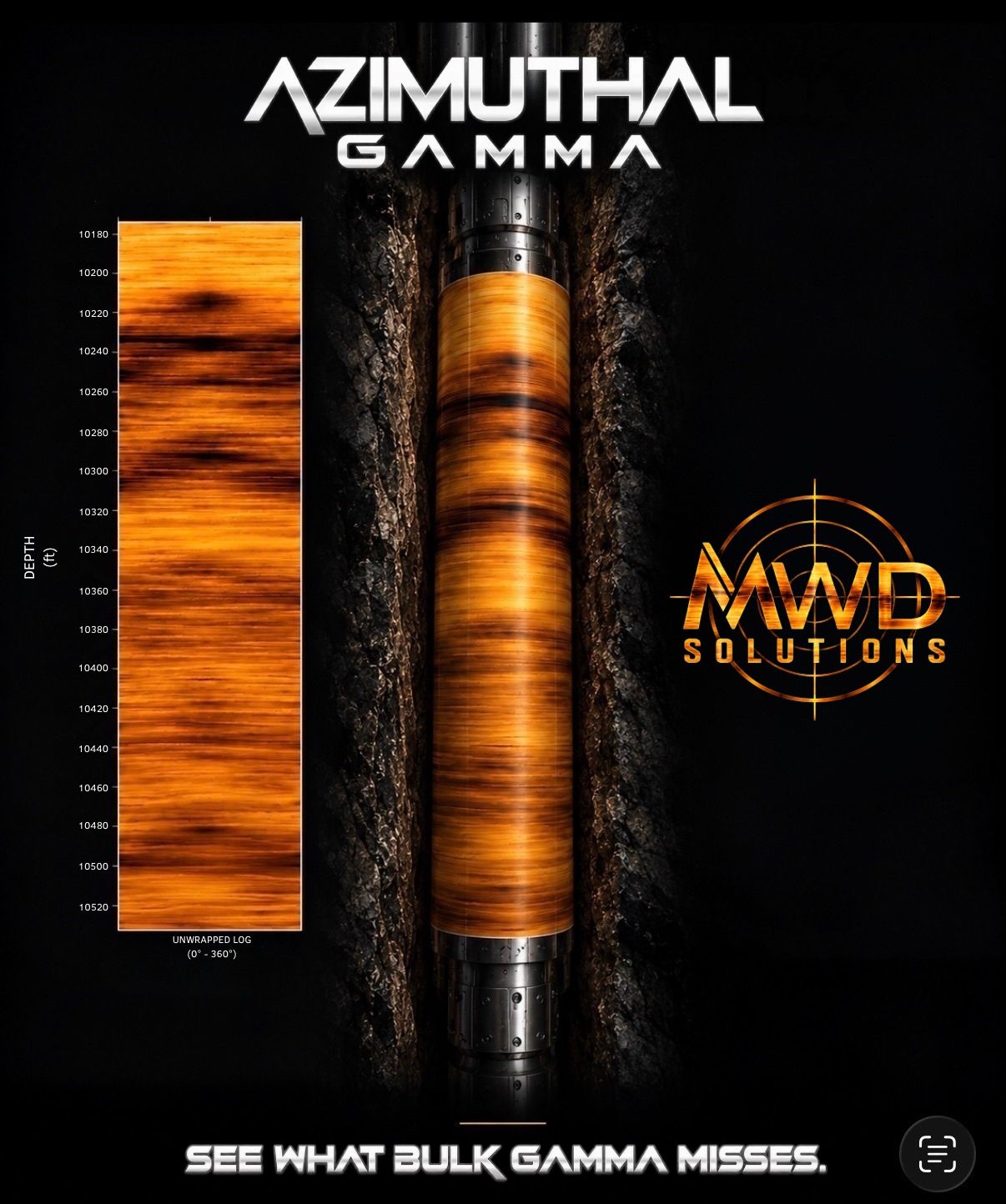
Interpretation depends on image orientation, borehole trajectory and geological context. An image shape alone is not a steering instruction.
Read the original perspective